Freitag, 27. April 2012

Another Equipotential


Iterative Step Modeling - grasshopper

playing around with the HOOPSNAKE TREE ATTRACTOR definition is SO MUCH FUN !

you can get it here: http://www.volatileprototypes.com/about/  - highly recommended website
thanks to Yiannis Chatzikonstantinou -great work !
Yiannis Chatzikonstantinou

Mittwoch, 25. April 2012

First Try - rhino plugin - Equipotential

some first session with the ingenious rhino plugin equipotential
 

check out more great stuff here http://www.sawapan.eu/ and download the equipotential plugin

Dienstag, 28. Februar 2012

next PARAMETRIC WORKSHOP in TOULOUSE


next Parametric Workshop will be taking place in Toulouse, South of France in May 2012 !

For further info, registration please contact: s.wiesenhuetter@artofliving.de

Montag, 20. Februar 2012

Suspended luminaire inspired by deep space creatures by Jakob+MacFarlane

Original post seen on Evolo
  Dominique Jakob and Brendan MacFarlane have created a light sculpture composed of blades and LEDs, a luminaire specially designed for Moaroom, a Paris-based furniture and art gallery. Since 2004 Moaroom works with designers and artists from New Zealand and presents a selection of creations from the world of design and visual arts. Aimed to explore design beyond the usual scope of trends and patterns, these works are inspired by nature and its needs, and are created in order to respect the environment.
“Both transparent and opaque, this fixture is conceived as a creature from the depths of the sea newly discovered, both unknown and unnamed. It belongs to a dark world, where new sounds, new experiences can be imagined and lived, “say the architects.
The suspended sculpture, composed of thin strips of aluminum and powered by LEDs, alternates between light and shadow. It is a 160x80x45 cm snake-shaped light source that flows organically through space, creating an impression of a moving organism. Hovering above the visitors to the gallery, this item brings the Studio’s continuous exploration of patterns and color into the realm of interior design.

Synthetic Grain by PROJECTiONE

 original post on designplpaygrounds


Synthetic Grain by PROJECTiONE utilizes computational design and digital fabrication techniques to mimic natural grain patterns and organic forms with synthetic manufactured materials. A grasshopper definition was created that adjusts parallel lines around a set of points or “knots” based on proximity to that point. The result is a three dimensionally curved, contoured surface made of laser cut polystyrene that lock into slots in a plywood backer. The project was developed to be made at various scales by changing material thicknesses and number of custom panels. This would allow for development as a building skin, retail storefront, or simply the backdrop for a bar. The manner in which the strips engage the wood allow for changing perceptions as the user moves past. While of the same language, each part is unique to its specific condition, similar to natural systems.
video on vimeo

Freitag, 17. Februar 2012

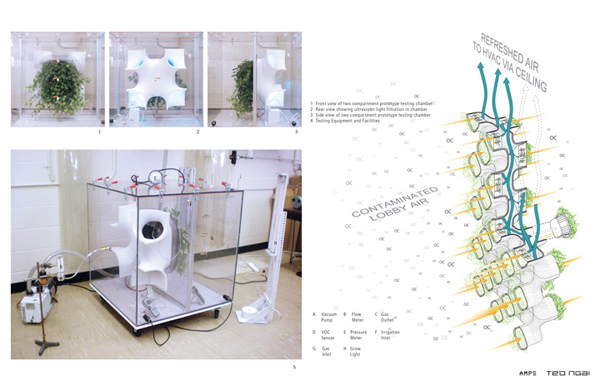
Bio-Mechanical Pod System Produces Fresh Air

The Active Phytoremediation Wall System is a modular system of pods, housing hydroponic plants. Its main purpose is to encourage airflow and contribute to the quality of life through its air cleaning capacities. The project is a result of a collaborative research between Rensselaer Polytechnic Institute and Skidmore, Owings & Merrill.
It is a bio-mechanical hybrid system that produces ‘fresh air’ from within buildings, thereby reducing the energy consumption. Because the plants’ roots are exposed, instead of being buried in soil, the plants’ air-cleaning capacity increases by 200 to 300 percent. The pods themselves are made from vacuum-formed plastic, and the form allows the maximum amount of air to reach the root rhizomes while using the minimum amount of material. It also creates a beautiful base for the plants. The wall system can be installed in large commercial interiors, but works equally well in small settings—a four-module system in an apartment would have the impact of 800 to 1200 house plants.
Researchers: Emily Rae Brayton, Ahu Aydogan
Testbed Site: Public Safety Answering Center II, Bronx, N.Y.
Architect: Skidmore, Owings & Merrill, New York—Carl Galioto (technical partner); Gary Haney (design partner); Peter Magill (managing partner); Rob Rothblatt (senior designer); Joseph Sacco (project manager); Carl Brown (technical coordinator); Julie Hiromoto (project team)


Freitag, 27. Januar 2012

Flight Assembled Architecture

original link on designplaygrounds

Gramazio & Kohler and Raffaello D’Andrea have launched a pioneering project around training dynamic and robotic procedures applied to architecture. Belonging to the younger generation of architects exploiting the digital tools in the architectural design and construction, Gramazio & Kohler join the engineer Raffaello D’Andrea, whose work concerns the study of algorithms and development of systems autonomous innovation. Together, they created Flight Assembled Architecture, an architectural research on the potential of a revolutionary assembly tool, revealing joint spatial and material previously unpublished. Flight Assembled Architecture is the first installation built entirely by flying robots. Designed as an architectural structure on the scale of a “vertical village” of 600 meters, Assembled Architecture Flight tests a new paradigm of design and manufacturing, through a physical process of automated dynamic training. This project builds on the simultaneous use of multiple mobile agents. Considered as tools for adaptive production, these flying robots are programmed to interact and to capture, transport and assemble the modules to build architectural structures. They synthesize and the pragmatism of Gramazio & Kohler Architecture and visionary approach to Raffaello D’Andrea in engineering dynamics. The FRAC Centre supports this new project, which will ad up to its collection devoted to experimental architecture. This collaborative project will be exposed in the FRAC Centre in Orléans.

Hyperbolic Tower

 Here you can find an excellent article about making a parametric tower
with grasshopper: generative design
(all images from http://geometricmind.wordpress.com)